
Share this post
The Amazon Conservation Team (ACT) celebrates the Colombian government’s recent decision to permanently designate the Sierra Nevada de Santa Marta — known to its Indigenous peoples as the Heart of the World — as a Renewable Natural Resources Reserve. Formalized through Resolution 0663 of 2026, issued by Colombia’s Ministry of Environment and Sustainable Development, this sweeping protection covers more than 1.5 million hectares across the departments of Magdalena, La Guajira, and Cesar.
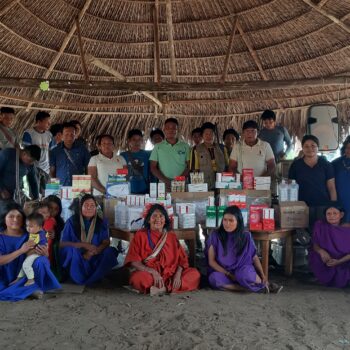
The declaration responds to a long-standing request from the Arhuaco, Kogui, Wiwa, and Kankuamo peoples — communities with whom ACT has worked closely for years to map sacred sites, document ancestral knowledge, and secure formal land rights. We congratulate Indigenous peoples and the Colombian government on this achievement, which is a big a milestone for Indigenous sovereignty and ecosystem conservation.
Years of partnership on the ground
For more than a decade, ACT has worked alongside the Indigenous communities of the Sierra Nevada de Santa Marta in support of their territorial rights and cultural heritage. Central to this collaboration has been the mapping of the Línea Negra — the Black Line — a ring of 348 sacred sites encircling the base of the Sierra that defines the ancestral territory of the region’s four Indigenous nations.
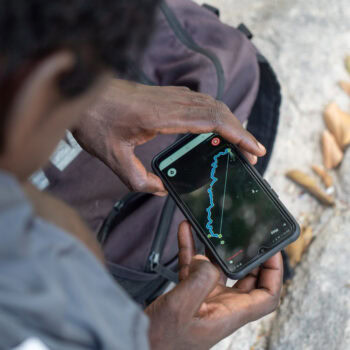
ACT has provided land-purchase support to the Kogui since 2015, including the acquisition of 528 acres of coastal wetlands and forests that encompass four4 sacred sites of the Black Line, known locally as Jaba Tañiwashkaka. ACT has supported the Kogui in reestablishing Indigenous presence and traditional management practices on the site, marking an important return of the Kogui to the coast, while also utilizing a combination of western and traditional environmental monitoring techniques to track the site’s recuperation.
ACT has also played a direct role in securing formal land titles for Sierra Nevada communities. Since 2019, ACT has collaborated with Indigenous partners and the Colombian government to achieve the legal titling of more than 2.63 million acres across 48 reserves in Colombia, benefiting more than 65,000 Indigenous people. Within the Sierra Nevada, this has included supporting multiple expansions of the Kogui-Malayo-Arhuaco (KMA) Indigenous Reserve, including the formal incorporation of Jaba Tañiwashkaka into the reserve..
Most recently, in 2025, ACT expanded its Native Place Names project with Kogui and Kankuamo partners, documenting the oral histories of 58 sacred sites along the Black Line to ensure Indigenous linguistic, cultural, and environmental knowledge is preserved in Colombia’s official national cartographic record.
A watershed moment for the Heart of the World
The Sierra Nevada de Santa Marta is the highest coastal mountain range on Earth, rising from the Caribbean coast to snow-capped peaks. Its ecosystems span tropical dry forests to high-altitude páramos, regulating water resources for millions of people across Colombia’s Caribbean region. The new reserve designation prohibits new mining and hydrocarbon concessions in the protected area and restricts environmental licenses for new extractive projects — directly addressing threats that ACT and its partners have documented, including findings that 34 percent of the Línea Negra faces pressure from mining, monoculture, and unregulated tourism.
For ACT, the announcement affirms that territories managed by Indigenous peoples are among the best-conserved ecosystems on the planet. The recognition of the Arhuaco, Kogui, Wiwa, and Kankuamo peoples as stewards of this landscape reflects the model of conservation ACT has championed throughout its work across South America and Central America.